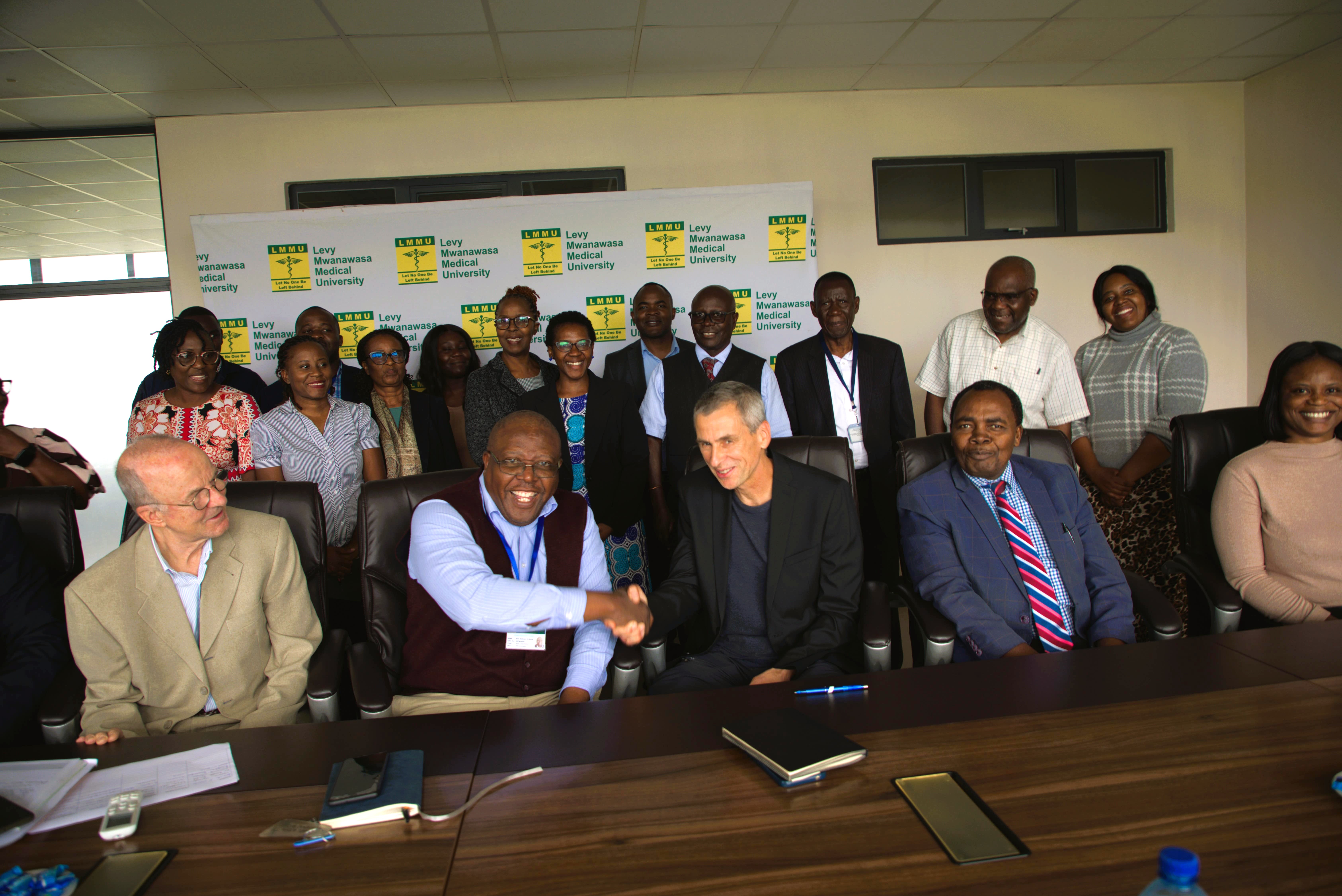
Lusaka, November 18, 2025. Levy Mwanawasa Medical University (LMMU) has officially launched the Medical Education Meeting Today’s Needs in Zambia with a Focus on Child Health (MEMENTO) project, marking a significant advancement in medical education, capacity building, and child health training in the country.
Speaking during the launch, LMMU Vice Chancellor, Professor Sekelani Banda, expressed gratitude for the successful funding of the initiative, made possible through an application and grant proposal developed by the Heidelberg Institute of Global Health (HIGH), a renowned research and training institution committed to strengthening global health through collaborative work across Africa and Asia.
Professor Banda noted that the launch of MEMENTO adds another important milestone to LMMU’s growing portfolio of collaborations, partnerships, and research initiatives. He emphasized that integrating such projects into the institution’s operational systems ensures structured planning, harmonised partnerships, and sustainable development across the university.
“This project now forms part of our official register of collaborations and capacity building programmes. This allows us to systematically facilitate and embed them into our operations, ensuring that institutional planning and partnership development remain cohesive and effective,” he said.
Representing the Heidelberg Institute of Global Health, Dr. Hans Jörg Lang, the project leader, highlighted the core aim of MEMENTO which is to strengthen child health outcomes in Zambia by adapting and implementing an Essential Paediatric and Emergency Critical Care (EPECC) training module into both pre service and postgraduate curricula at LMMU.
Dr. Lang explained that the project is being implemented in collaboration with LMMU and the Zambian Paediatric Association (ZPA) and employs an innovative mix of proven teaching methods, including practical skills training, clinical simulation, competency based learning rooted in real world clinical settings, mentorship by experienced clinicians, e learning modules and interactive tutorials, and an interactive e logbook to enhance mentorship and streamline training coordination.
MEMENTO will also utilize a decentralized capacity building model, running programs at LMMU in Lusaka as well as at peripheral teaching units across the country. Through a training of trainers (TOT) approach, the project aligns with the strategies of both LMMU and ZPA to develop a sustainable network of first line medical educators nationwide.
Ultimately, the project is designed to contribute to reducing child mortality rates and improving the resilience of Zambia’s regional health systems.
By Levy Mwanawasa Medical University
Public Relations Unit